
Federal courts block Trump’s National Guard deployment to Portland
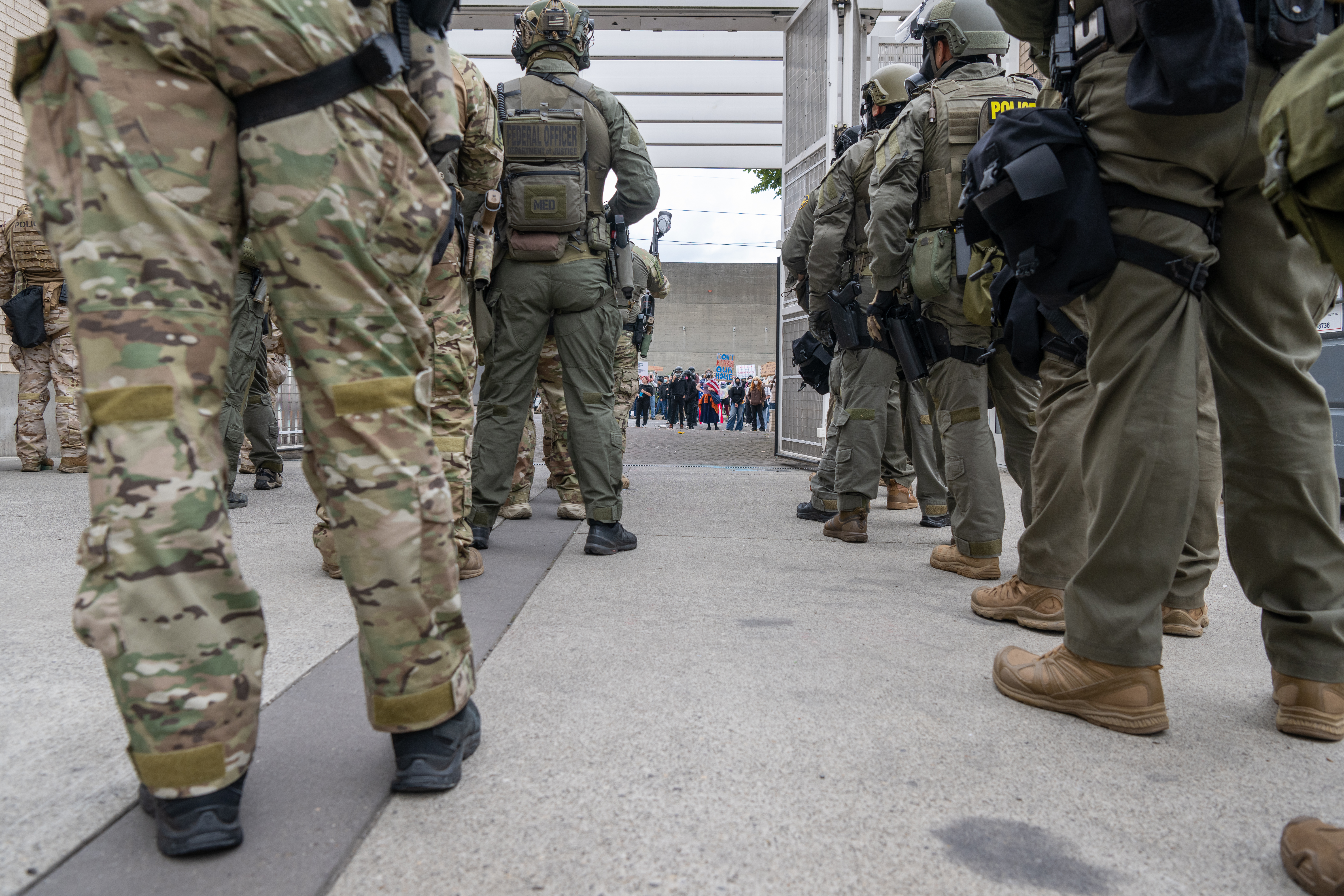
DHS and U.S. Bureau of Prisons officers guarding the Portland ICE facility on Oct. 4, 2025. ICE/Handout
WASHINGTON, Jan. 6 (ZFJ) — President Donald Trump’s attempt to deploy National Guard soldiers to Portland, Oregon, has been blocked by the federal courts.
Trump has had longstanding grievances with Portland, labeling it a “sanctuary jurisdiction” due to Oregon state law prohibiting local and state law enforcement assistance in federal immigration operations.
From June through September 2025, demonstrations took place outside of a facility belonging to U.S. Immigration and Customs Enforcement (ICE) in Southwest Portland following increased federal immigration enforcement activity in the city. The Portland Police Bureau (PPB) responded to what Oregon has characterized as “small” protests, most often involving fewer than 100 protesters, although this number did increase to over 100 at times.
On Sept. 4, 2025, Fox News aired a misleading report on the protests outside the Portland ICE facility that used video of protests in the city from 2020 to portray demonstrators as violent rioters attacking ICE agents.
Following the Fox report, Trump repeatedly told reporters at events that he would send soldiers into Portland. On Sept. 27, 2025, he posted on Truth Social saying that he was sending the National Guard “to protect War ravaged Portland, and any of our ICE Facilities under siege from attack by Antifa, and other domestic terrorists.”
After Oregon Governor Tina Kotek rejected a federal request to mobilize troops under Title 32 status, on Sept. 28, 2025, U.S. Secretary of Defense Pete Hegseth federalized 200 Oregon National Guard (ORNG) soldiers under Title 10 status.
DISTRICT COURT - TEMPORARY RESTRAINING ORDERS
Oregon filed its civil complaint on Sept. 28, 2025. The case was initially assigned to U.S. District Judge Michael H. Simon. Simon voluntarily recused himself on Oct. 2, 2025, at the suggestion of the Trump administration because his wife, U.S. Rep. Suzanne Bonamici, represents Portland and publicly expressed that the impending Guard deployment would be illegal. Following Simon’s recusal, the case was randomly assigned to U.S. District Judge Karin J. Immergut.
On Oct. 4, 2025, Immergut issued a temporary restraining order blocking the federalization and deployment of any Oregon guardsmen to Portland.
Immergut noted that witness declarations submitted by both sides detailed some incidents of disorderly conduct and limited damage to the ICE facility during protests. Portland officials explained the PPB’s protest response mechanisms, such as the use of its Rapid Response Team, Crowd Management Incident Commanders, and mutual aid with agencies like the Multnomah County Sheriff’s Office (MCSO) and Oregon State Police (OSP).
The judge did not find it likely that the Trump administration would prevail on a claim under Title 10 that it was “unable with the regular forces to execute the laws of the United States.” Per the preliminary record, law enforcement had been able to maintain order.
“As of September 27, 2025, it had been months since there was any sustained level of violent or disruptive protest activity in Portland,” wrote Immergut. “During this time frame, there were sporadic events requiring either PPB monitoring or federal law enforcement intervention, but overall, the protests were small and uneventful.”
The Trump administration’s declarations detailed some incidents that, while “inexcusable,” were “nowhere near the type of incidents that cannot be handled by regular law enforcement forces.”
Oregon provided all PPB call logs for September, showing that local police worked closely with the Federal Protective Service (FPS) and monitored the ICE facility closely.
The Trump administration argued that FPS resources were strained, but Immergut said that it only showed that the transfer of 115 FPS officers to Portland “reduced the level of disorder between June and September” to the point where there were only 20 or fewer protesters at the facility.
“If the President could equate diversion of federal resources with his inability to execute federal law, then the President could send military troops virtually anywhere at any time,” wrote the judge.
She ended her opinion noting that, even with great deference to the president’s determinations, his claims of “professional agitators” and “rioters” were completely contrary to the facts on the ground and were not made in good faith.
The first temporary restraining order, effective for 14 days, was appealed to the 9th Circuit.
The next day, Oct. 5, 2025, Oregon, now joined by California, requested an expedited hearing on an updated temporary restraining order because the Trump administration had moved to deploy 200 California National Guard (CANG) members to Portland instead.
An emergency hearing was scheduled for 7:00 p.m. that night by phone. Following the proceeding, Immergut updated her temporary restraining order to prohibit the Trump administration from deploying any federalized guardsmen in Oregon.
9TH CIRCUIT - STAY
The 9th Circuit stayed Immergut’s first order on Oct. 20, 2025.
U.S. Circuit Judges Susan P. Graber, Ryan D. Nelson, and Bridget S. Bade reviewed the Trump administration’s appeal of Immergut’s order. Nelson, who wrote a concurrence, and Bade are both Trump appointees. Graber, who dissented, is a Bill Clinton appointee.
According to the per curiam opinion, the 9th Circuit panel found that, based on the preliminary record, Trump lawfully used his Title 10 authority to federalize the Guard and made “colorable assessment of the facts and law within a ‘range of honest judgment’” about protest conditions.
To assert that federal immigration enforcement operations had been impeded by protesters, the court said that damage and threats from protesters had forced DHS to close the Portland ICE facility from June 13 to July 7. The opinion also lists other incidents requiring a police response, such as a barricade set on fire, a protester carrying a firearm, a burning of the U.S. flag, and regular blocking of vehicles exiting the facility. It notes that DHS officers deployed crowd control munitions like pepper balls and gas.
In line with public statements by high-ranking DHS officials, the opinion also specifically lists the protesters following and doxing FPS and ICE officers as threats. The opinion also says that a PPB officer said that “several older homeless people” were “coerced into approaching the ICE facility gate.”
“FPS took custody of an elderly man after he asked ‘if he could just come up to the gate and rattle it so the antifa instigators would leave him and others alone,’” reads the opinion.
The per curiam opinion said that the number of protesters generally ranged from a few to around 200. It said that PPB told FPS that it would only respond to “life/safety situations” and that FPS “rely almost exclusively on ICE and SRT for assistance in preventing violent protesters from attacking officers and the facility in which they work.” SRT refers to ICE’s Special Response Teams under its Enforcement and Removal Operations branch.
“Detailing HSI SRT Special Agents to Portland diminishes HIS’s operational capabilities nationwide,” reads the opinion.
The opinion says that the district court erred in not giving the president’s interpretation of the facts high deference.
“Instead, the district court substituted its own assessment of the facts for the President’s assessment of the facts,” writes the appeals court. “This is the opposite of the significantly deferential standard of review that applies to the President’s decision to invoke § 12406(3) and federalize members of the National Guard.”
The appeals court said that the district court ignored “most of the evidence of events in Portland from June through September” and that the power to make a determination about the level of violence rests solely with the president.
The 9th Circuit said that the district court placed too heavy an emphasis on the president’s social media posts, saying that “other facts” still provided a sufficient basis to assert that “rebellion” was ongoing in Portland.
It also heavily credits the “executive’s internal assessment of its ability to enforce the laws,” saying that “the record reflects that 115 FPS officers—nearly 25% of FPS officers nationwide—were diverted to Portland.” It additionally points to DHS declarations that this shift of assignments “strained resources.”
In his concurrence, Nelson primarily highlights that “under current Supreme Court precedent, presidential determinations under § 12406 are not reviewable by federal courts” and that the states had no standing to sue because they “lack an injury in fact.”
In her dissent, Graber said the 9th Circuit’s decision was “absurd” and “erodes core constitutional principles, including sovereign States’ control over their States’ militias and the people’s First Amendment rights to assemble and to object to the government’s policies and actions.”
She disagreed with the majority’s assessment that the facts on the ground agreed with Trump’s determination that he could not enforce the law. She said that local police were fully able to handle any disorder at the ICE facility.
“The district court’s factual findings, which the government does not challenge on appeal, and which are not clearly erroneous in any event, fully resolve this issue,” she wrote. “In the two weeks leading up to the President’s September 27 social media post, there had not been a single incident of protesters’ disrupting the execution of the laws.”
Graber rejected the government’s argument that its resources were strained, noting that “the trigger for federalizing the National Guard is an inability to execute the laws, not staffing difficulties that fall short of demonstrably resulting in an inability to execute the laws.” She observed that the 115 officers transferred in figure didn’t specify how many officers were in Portland at any instant.
“For all we know, FPS sent a different 8 officers to Portland every week for 14 or 15 weeks, meaning that Portland’s drain on FPS’s staff from elsewhere on any particular day was 8 people, not 115,” she wrote.
She added that there was “no evidence that the sporadic violent events occurring over a handful of days during four months of otherwise peaceful protests were in any way organized.” As such, she did not see a basis to determine that a “rebellion” was happening in Portland.
Responding to the majority’s incidents of violence it listed, she said in a footnote, “the acts of violence catalogued in the record—heavily emphasized by the majority’s order and the concurrence—do not reflect the day-to-day reality of the protests, particularly in the weeks leading up to September 27. On most days, the most notable aspect of the demonstrations here was the presence of people dressed in chicken, frog, or birthday suits.”
Garber ended her dissent by writing, “I urge my colleagues on this court to act swiftly to vacate the majority’s order before the illegal deployment of troops under false pretenses can occur. Above all, I ask those who are watching this case unfold to retain faith in our judicial system for just a little longer.”
Garber’s appeal to her fellow circuit judges was answered quickly. The day the opinion was issued, one of her colleagues requested the court vote on rehearing the case en banc, or with the full court.
On Oct. 27, 2025, the U.S. Department of Justice (DOJ) admitted in an appeals court filing that the 115 FPS officers deployed figure used to argue that federal resources were strained was wrong.
“Based on DHS’s review of the deployment data, the number of individual FPS officers deployed during the time period appears to be 86 officers,” wrote the DOJ.
On Oct. 28, 2025, by a majority vote of nonrecused active circuit judges, the 9th Circuit ordered that the case be reheard en banc. As a result of this procedure—extremely rarely successful—the Oct. 20 decision was vacated.
DISTRICT COURT - JUDGMENT
Immergut held a three-day bench trial from Oct. 29, 2025, to Oct. 31, 2025. The second temporary restraining order was active at the start of the trial. On Nov. 2, 2025, she issued a preliminary injunction against any deployment of the Guard in Oregon.
Immergut issued her judgment on Nov. 7, 2025. Based on the evidence presented at trial, she found that the attempted Guard federalization exceeded the president’s authority and violated the Tenth Amendment. She concluded that the president did not meet the statutory requirements under Title 10 to use the Guard in the event of a rebellion or inability to enforce the law.
“While violent protests did occur in June, they quickly abated due to the efforts of civil law enforcement officers,” she wrote in her findings of fact. “And since that brief span of a few days in June, the protests outside the Portland ICE facility have been predominately peaceful, with only isolated and sporadic instances of relatively low-level violence, largely between protesters and counter-protesters.”
“When considering these conditions that persisted for months before the President’s federalization of the National Guard, this Court concludes that even giving great deference to the President’s determination, the President did not have a lawful basis to federalize the National Guard under 10 U.S.C. § 12406.”
Immergut noted that the Trump administration violated the first restraining order by stationing nine guardsmen at the ICE facility on Oct. 4, 2025, for seven hours, although she did not issue a finding of contempt.
Per trial evidence, the judge said that the number of protesters peaked mid-June with maximum sizes of 450, 300, and 200 protesters on three days respectively. Most days saw sizes between 25 to 100 people, and September saw large drops in which federal officers usually outnumbered protesters at the facility. Based on the testimony of a PPB commander, she found that Antifa is not an “organized group where you have membership.” Thus, there was no credible evidence that an organization directed protests.
Police confirmed the presence of firearms only three times, and they were never pointed at anyone else. Some protesters carried blades or pepper spray, each of which was used exactly once against a federal officer, but the vast majority of people did not carry these weapons. A stick was used against officers in only one instance, so the judge did not find that bats were intended to be used against federal agents. As such, Immergut ruled that most protesters were peaceful and instances where weapons were used caused “minimal interference.”
The judge did not find DHS officials’ testimony on damage to be consistent with the factual record. She noted that, while the facility was closed for a period due to damage, ICE was still able to process people, and administrative functions continued in another location. While protesters did try to block vehicles at the facility, federal officers were still able to clear the people and drive in and out.
DHS officials’ testimony on injuries to federal officers was inconsistent with FPS and PPB reporting. DHS did not offer photo or video evidence to corroborate the testimony, despite having working cameras at the facility. While FPS was the target of many threats, none of them resulted in real violence. PPB responded twice for bomb threats and found no explosives both times. Officers who were injured only experienced low-intensity violence, such as pulling a muscle or getting pushed, with a single instance of an officer kicked by someone. The judge did not find sufficient evidence to link reported doxing incidents to the facility protesters. The real and threatened violence incidents peaked mid-June and decreased rapidly in the following months.
Immergut found that PPB had executed its duty to maintain order at the facility and responded to federal calls for assistance in both serious and even minor criminal activity. PPB revised policies to improve communication with FPS while following state law prohibiting assisting immigration enforcement. After the first week of responding, it lowered the police intervention threshold from “life safety situations” to “both misdemeanor and felony-level crimes” at the facility. FPS frequently called PPB about disputes between protesters and counter-protesters that could not always be prioritized for a local police response. In one case, FPS called PPB six times in a night for the same incident with a counter-protester.
Per trial evidence, Immergut found that federal officers were able to protect the facility despite any strain on resources. The federal officials in charge of protecting the facility were not consulted about and did not request the Guard. Officials also testified that federal immigration enforcement was able to continue, even when the facility was temporarily closed and with staffing issues.
Referencing Newsom v. Trump, in which a federal judge in California rejected “minimal interference with the execution of laws” as a basis to deploy the Guard, Immergut found no basis to conclude that the protest activity significantly impeded immigration enforcement in Portland.
Since trial evidence did not show that protesters acted together to try to take over the ICE facility unlawfully or wage armed warfare against the government, Immergut concluded that there was no danger of rebellion for which the president could deploy the Guard. PPB declared a riot on June 14, which was the closest incident to a “rebellion,” but there was no evidence at trial to show that it was not spontaneous, so it did not constitute a rebellion.
Based on these findings, Immergut permanently enjoined the Trump administration from federalizing and deploying any guardsmen in Oregon.
The federal government appealed Immergut’s findings of fact to the 9th Circuit, which, on Nov. 19, 2025, stayed only the part of the injunction that prevents federalizing the Guard.
The cases are State of Oregon v. Trump (3:25-cv-01756-IM) in the U.S. District Court for the District of Oregon and State of Oregon v. Trump (25-6268) in the U.S. Court of Appeals for the Ninth Circuit.
References
- U.S. District Court for the District of Oregon (ORDC) - State of Oregon v. Trump (3:25-cv-01756-IM)
- ECF No. 1 - COMPLAINT - https://www.zfjnews.com/2026/domestic-affairs/D.Or._3_25-cv-01756-IM_1_0-2.pdf
- ECF No. 22 - BRIEF - https://www.zfjnews.com/2026/domestic-affairs/D.Or._3_25-cv-01756-IM_22_0.pdf
- ECF No. 56 - ORDER ON MOTION FOR TEMPORARY RESTRAINING ORDER - https://www.zfjnews.com/2026/domestic-affairs/D.Or._3_25-cv-01756-IM_56_0.pdf
- ECF No. 59 - MOTION FOR TEMPORARY RESTRAINING ORDER - https://www.zfjnews.com/2026/domestic-affairs/D.Or._3_25-cv-01756-IM_59_0.pdf
- ECF No. 68 - ORDER ON MOTION FOR TEMPORARY RESTRAINING ORDER - https://www.zfjnews.com/2026/domestic-affairs/D.Or._3_25-cv-01756-IM_68_0.pdf
- ECF No. 134 - OPINION AND ORDER - https://www.zfjnews.com/2026/domestic-affairs/D.Or._3_25-cv-01756-IM_134_0.pdf
- ECF No. 146 - FINDINGS OF FACT - https://www.zfjnews.com/2026/domestic-affairs/D.Or._3_25-cv-01756-IM_146_0.pdf
- ECF No. 147 - JUDGMENT - https://www.zfjnews.com/2026/domestic-affairs/D.Or._3_25-cv-01756-IM_147_0.pdf
- U.S. Court of Appeals for the Ninth Circuit (09CA) - State of Oregon v. Trump (25-6268)
- ECF No. 61 - ORDER FOR PUBLICATION - https://www.zfjnews.com/2026/domestic-affairs/9th.Cir.25-6268_61_1.pdf
- ECF No. 63 - ORDER - https://www.zfjnews.com/2026/domestic-affairs/9th.Cir.25-6268_63_1.pdf
- ECF No. 88 - CITATION - https://www.zfjnews.com/2026/domestic-affairs/9th.Cir.25-6268_88_1.pdf
- ECF No. 89 - ORDER FOR PUBLICATION - https://www.zfjnews.com/2026/domestic-affairs/9th.Cir.25-6268_89_1.pdf
- ECF No. 90 - ORDER FOR PUBLICATION - https://www.zfjnews.com/2026/domestic-affairs/9th.Cir.25-6268_90_1.pdf
- ECF No. 96 - ORDER FOR PUBLICATION - https://www.zfjnews.com/2026/domestic-affairs/9th.Cir.25-6268_96_1.pdf
- Donald J. Trump - @realDonaldTrump (Truth Social) - https://truthsocial.com/@realDonaldTrump/posts/115276694936263266 At the request of Secretary of Homeland Security, Kristi Noem, I am directing Secretary of War, Pete Hegseth, to provide all necessary Troops to protect War ravaged Portland, and any of our ICE Facilities under siege from attack by Antifa, and other domestic terrorists.