
Federal courts block Trump’s National Guard deployment to Chicago
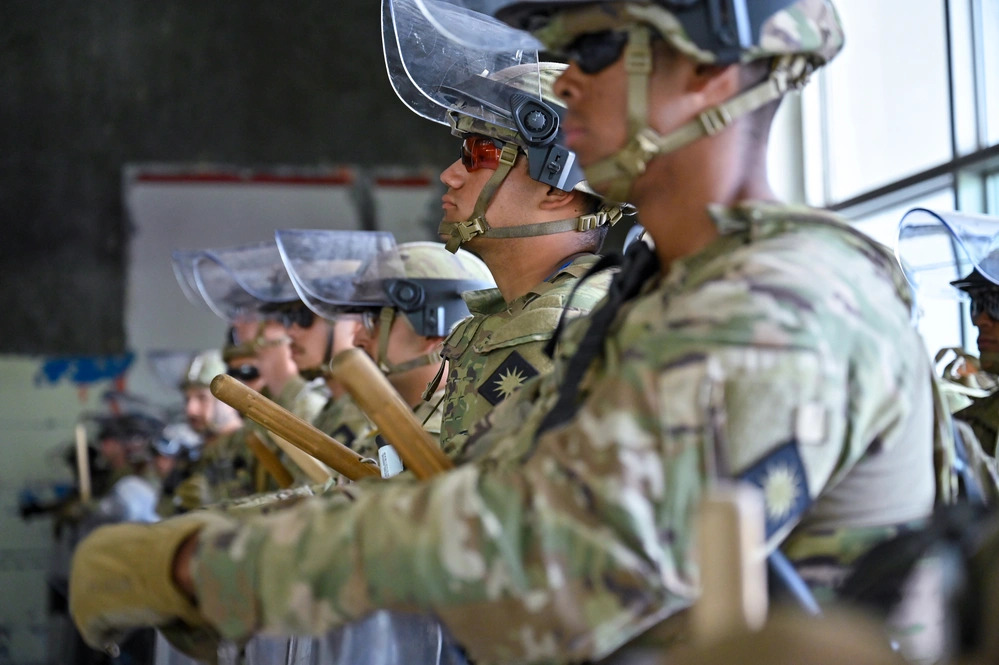
California National Guard members deployed to Los Angeles on June 22, 2025. DVIDS/Christy Sherman
WASHINGTON, Jan. 2 (ZFJ) — President Donald Trump’s attempt to deploy National Guard soldiers to Chicago has been blocked by the federal courts.
Trump has had longstanding grievances with Chicago, labeling it a “sanctuary jurisdiction” due to Illinois state law prohibiting local and state law enforcement assistance in federal immigration operations.
Following the deployment of National Guard soldiers to patrol Washington, D.C., Trump posted on Truth Social throughout August and September to criticize the handling of crime by Illinois Governor JB Pritzker, an outspoken critic of the D.C. operation. One such post had an AI-generated picture of Trump, dressed as an army officer, dropping napalm on Chicago.
OPERATION MIDWAY BLITZ
The U.S. Department of Homeland Security (DHS) began “Operation Midway Blitz” on Sept. 8, 2025. Border Patrol commander Gregory Bovino was brought in from Los Angeles to lead federal immigration agents on a violent arrest spree through Chicago.
Agents were documented smashing car windows and deploying tear gas in neighborhoods, and they also fatally shot a man. In one case, agents crashed into a woman’s truck and accused her of targeting them in a vehicle ramming attack. The Justice Department has since dropped all charges against her.
The operation involved the use of a processing center belonging to U.S. Immigration and Customs Enforcement (ICE) in Broadview, a Chicago suburb. Regular demonstrations were held outside of this facility, with turnout starting small (less than 100 people) and increasing in size as the Chicago operation progressed. DHS agents in camouflage and tactical gear regularly deployed chemical munitions against the protesters.
State and local agencies, including the Broadview Police Department (BPD), Illinois State Police (ISP), and Cook County Sheriff’s Office (CCSO) worked to secure the area around the Broadview ICE facility. However, White House officials said that dangerous “Radical Left” protesters were making it unsafe for DHS agents to operate.
On Oct. 4, 2025, Trump federalized 300 members of the Illinois National Guard (ILNG) under Title 10 status to protect federal properties and agents involved in immigration operations after Pritzker declined a request to mobilize the troops under Title 32 status. The next day, the Illinois guard received a memo from the U.S. Department of Defense (DOD) that mobilized up to 400 members of the Texas National Guard (TXNG) for deployment to Chicago and Portland, Oregon.
DISTRICT COURT PROCEEDINGS
Illinois secured a temporary restraining order from U.S. District Judge April M. Perry blocking the deployment on Oct. 9, 2025, and in a hearing on Oct. 22, 2025, both parties agreed to extend it until a final judgment on the merits.
In an opinion released Oct. 10, 2025, Perry pointed out that the ICE processing center in Broadview “has continuously remained open and operational throughout the protest activity.”
She observed that DHS reported “significantly more violence” in the Chicago area than local and state police did. However, she did not find the declarations of DHS officials to be credible, noting that federal grand juries refused to return indictments against at least three individuals that federal officials accused of assaulting federal agents.
Continuing on about credibility, Perry also noted that the court in a separate case issued a temporary restraining order against Secretary of Homeland Security Kristi Noem, finding that it is likely that the Broadview protesters would be able to show that ICE violated their First Amendment rights.
“Although this Court was not asked to make any such finding, it does note a troubling trend of Defendants’ declarants equating protests with riots and a lack of appreciation for the wide spectrum that exists between citizens who are observing, questioning, and criticizing their government, and those who are obstructing, assaulting, or doing violence,” writes Perry. “This indicates to the Court both bias and lack of objectivity.”
Perry added that DHS had submitted a declaration that falsely asserted that the Federal Protective Service (FPS) had requested federalized guardsmen to protect the district court.
The judge agreed with Illinois that the evidence showed that the Trump administration believes crime is out of control in Chicago and that it has strong disagreements with the state over sanctuary policies.
Perry pointed out that Trump had not made a factual determination that a rebellion was imminent. She remained unconvinced that civilian authorities were unable to enforce the law adequately.
“Here, there has been no showing that the civil power has failed,” she wrote. “The agitators who have violated the law by attacking federal authorities have been arrested. The courts are open, and the marshals are ready to see that any sentences of imprisonment are carried out. Resort to the military to execute the laws is not called for.”
Perry declined to evaluate the merits of claims advanced by Illinois on the basis of the Tenth Amendment and Posse Comitatus Act since she already determined a likelihood of success based on other factors.
APPEALS COURT PROCEEDINGS
The Trump administration appealed the temporary restraining order to the 7th Circuit. Judges Ilana Diamond Rovner, David F. Hamilton, and Amy J. St. Eve heard the case. The judges were appointed by Ronald Reagan, Bill Clinton, and George W. Bush, respectively.
All three judges affirmed Perry’s order on Oct. 16, 2025. They concluded that the district court’s preliminary factual findings were not clearly erroneous and that, even with substantial deference to the president, the facts did not justify a Guard deployment.
Based on the preliminary factual record, the panel of judges agreed with Perry’s decision to credit declarations submitted by Illinois over those of the Trump administration.
Noting a distinction between “deliberate, organized violence to resist governmental authority” and “political opposition,” the 7th Circuit saw “insufficient evidence of a rebellion or danger of rebellion in Illinois.”
On the issue of whether or not the president was “unable with the regular forces to execute the laws of the United States” (the Title 10 condition for National Guard federalization), the 7th Circuit pointed to the fact that federal facilities have remained open, that “sporadic disruptions” were contained by authorities on scene, and that, according to DHS press releases, immigration arrests and deportations in Chicago have been successful. On this basis, the court found that Trump was unlikely to prevail arguing that he could not enforce immigration law in Chicago.
On a similar basis, the court found that Trump was unlikely to prevail on a Tenth Amendment argument.
The cases are State of Illinois v. Trump (1:25-cv-12174) in the U.S. District Court for the Northern District of Illinois and State of Illinois v. Donald J. Trump (25-2798) in the U.S. Court of Appeals for the Seventh Circuit.
References
- U.S. District Court for the Northern District of Illinois (ILND) - State of Illinois v. Trump (1:25-cv-12174)
- ECF No. 1 - COMPLAINT - https://www.zfjnews.com/2026/domestic-affairs/N.D.Ill._1_25-cv-12174_1_0.pdf
- ECF No. 13-10 - MEMORANDUM IN SUPPORT OF MOTION - EXHIBIT 9 - https://www.zfjnews.com/2026/domestic-affairs/N.D.Ill._1_25-cv-12174_13_10.pdf
- ECF No. 67 - TEMPORARY RESTRAINING ORDER - https://www.zfjnews.com/2026/domestic-affairs/N.D.Ill._1_25-cv-12174_67_0.pdf
- ECF No. 70 - MEMORANDUM OPINION AND ORDER - https://www.zfjnews.com/2026/domestic-affairs/N.D.Ill._1_25-cv-12174_70_0.pdf
- ECF No. 98 - TEMPORARY RESTRAINING ORDER - https://www.zfjnews.com/2026/domestic-affairs/N.D.Ill._1_25-cv-12174_98_0.pdf
- U.S. Court of Appeals for the Seventh Circuit (07CA) - State of Illinois v. Donald J. Trump (25-2798)
- ECF No. 26 - ORDER - https://www.zfjnews.com/2026/domestic-affairs/7th.Cir._25-2798_26_1.pdf
- Donald J. Trump - @realDonaldTrump (Truth Social) - https://truthsocial.com/@realDonaldTrump/posts/115158096026629509
- The White House - Department of War Security for the Protection of Federal Personnel and Property in Illinois - https://www.whitehouse.gov/presidential-actions/2025/10/department-of-war-security-for-the-protection-of-federal-personnel-and-property-in-illinois/ (ARCHIVE)