
Supreme Court blocks Trump’s National Guard deployment to Chicago
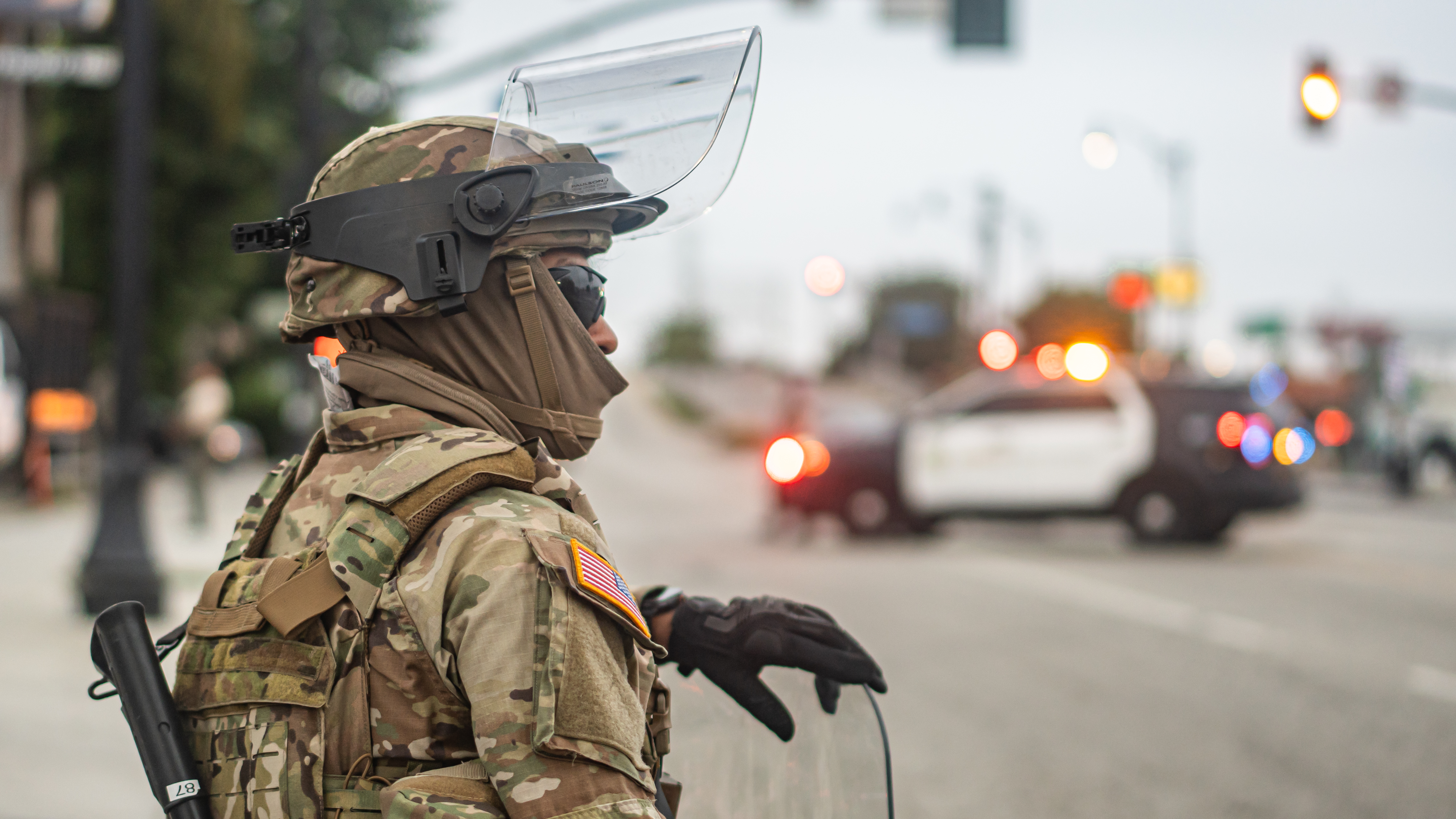
A federalized California National Guard (CANG) soldier protects a federal law enforcement operation in Los Angeles on June 13, 2025. DVIDS/Chase Murray
WASHINGTON, Jan. 16 (ZFJ) — The Supreme Court denied President Donald Trump’s emergency appeal to allow him federalize the Illinois National Guard (ILNG) and deploy soldiers to Chicago on Dec. 23, 2025.
Trump has sought to deploy the National Guard to Washington, D.C.; Los Angeles; Chicago; Memphis, Tennessee; and Portland, Oregon. In the cases of D.C. and Memphis, he said such a deployment was necessary to stop rampant crime. In the cases of Los Angeles, Chicago, and Portland, he said it was needed to protect federal immigration operations, which have encountered significant public backlash due to federal officers’ violent tactics.
Guardsmen are currently on the streets of D.C. in Title 10 status (under federal command) and Memphis in Title 32 status (so, with the governor’s consent). They made it to the streets in L.A. but were blocked by federal courts in Chicago and Portland. Federal courts in L.A. and Portland have issued final judgments finding that Trump’s deployments were illegal.
The Chicago case, in which both the district and appeals courts ruled against Trump, was the first Guard deployment lawsuit to make it to the Supreme Court. The president had federalized 300 members of the ILNG as well as members of the Texas National Guard (TXNG) on the basis that he was unable to execute immigration enforcement due to protests at a U.S. Immigration and Customs Enforcement (ICE) facility in Broadview, Illinois.
The Supreme Court offered an unsigned opinion for its order blocking the Chicago deployment. Justices Samuel Alito, Clarence Thomas, and Neil Gorsuch dissented.
AGAINST THE CHICAGO NATIONAL GUARD DEPLOYMENT
The majority primarily discussed the definition of “regular forces” under Title 10, since the statutory requirement for the president to deploy the National Guard for domestic law enforcement requires that he be “unable with the regular forces to execute the laws of the United States.”
While the Trump administration argued that “regular forces” means civilian law enforcement officers like ICE or Federal Protective Service (FPS) officers, the majority instead found that the term refers to the regular forces of the U.S. military (ex. the U.S. Army, U.S. Navy).
Since the Title 10 statute “requires an assessment of the military’s ability to execute the laws, it likely applies only where the military could legally execute the laws.”
Under the Posse Comitatus Act, the president requires constitutional or congressional authorization to use the military for domestic law enforcement. On this basis, the majority reasons that he must have statutory or constitutional authority to enforce the law with the military, and must also be “unable” to enforce the law with the military, in order to be able to federalize the National Guard.
The Trump administration has argued that the president has the inherent constitutional authority to use the military to protect federal personnel and property, but has also asserted that protective missions aren’t defined as “execut[ing] the laws” under the Posse Comitatus Act, so the majority was not convinced that the functions would be “execut[ing] the laws” under the Title 10 statute.
As the Trump administration had failed to show a source of authority for him to federalize the Guard, the majority left the district court’s temporary restraining order against the deployment in place.
Justice Brett Kavanaugh filed a concurring opinion to deny Trump’s appeal on narrower grounds. He agreed on the definition of “regular forces,” but wrote that the president’s lack of a determination that he is “unable” to enforce the law with the military was sufficient grounds for denial.
Kavanaugh said that he would have “at least invited further briefing and possibly also held oral argument,” which the court has done previously, before reaching a decision.
In a footnote, Kavanaugh writes that federal immigration officers “must not make interior immigration stops or arrests based on race or ethnicity” and “must not employ excessive force.” The justice appears to be attempting to walk back the Kavanaugh stops that he allowed the federal government to continue executing in a September emergency docket ruling. The government does not appear to have made any modifications to its tactics since the footnote was published.
FOR THE CHICAGO NATIONAL GUARD DEPLOYMENT
Alito filed a dissenting opinion, joined by Thomas, to address his belief that “the Court has unnecessarily and unwisely departed from standard practice” by addressing the “regular forces” question, which was brought up in an amicus brief, not by Illinois.
He wrote that the district court was not sufficiently deferential to the president’s authority and that immigration officers have faced “injuries, threats, vandalism, and harassment” from “rioters” that “have significantly impaired efforts to execute the laws.” This assessment is consistent with the position of U.S. Department of Homeland Security (DHS) officials that U.S. District Judge April M. Perry did not find to be credible based on the preliminary record.
Alito also disagreed with the majority’s statutory interpretations, writing that the statutes would allow the president to use the guardsmen “for purely protective purposes.”
“Whatever one may think about the current administration’s enforcement of the immigration laws or the way ICE has conducted its operations, the protection of federal officers from potentially lethal attacks should not be thwarted,” he said.
Gorsuch filed a dissenting opinion to assert that he is “not comfortable venturing an answer” to the statutory questions addressed by the majority. He believes that the declarations of federal law enforcement officials submitted to the district court provide sufficient grounds to allow the Guard deployment, referring to Alito’s reasoning.
MOVING FORWARD
The Supreme Court ruling is a rare loss for the Trump administration before the high court and a major obstacle for the president’s ongoing and planned Guard deployments.
The Supreme Court order doesn’t mean it’s impossible for Trump to deploy military forces for domestic law enforcement. He could try to identify an alternative statutory or constitutional authority to federalize the Guard.
Kavanaugh additionally observed in a footnote that the Court didn’t address the Insurrection Act, which allows the president to use the U.S. military or Guard to enforce the law on American soil in the event of an “insurrection” or “rebellion,” such as the Confederacy’s attempted secession from the Union during the Civil War.
The Insurrection Act, which has a high statutory bar for invocation and has rarely been used, has also been invoked by Presidents Dwight D. Eisenhower and John F. Kennedy to desegregate southern schools following the Supreme Court’s Brown v. Board of Education ruling.
Presidents have used the Insurrection Act during riots where local authorities were unable to maintain order. The most recent invocation was by President George H.W. Bush during the 1992 L.A. riots.
Illinois Governor JB Pritzker celebrated the Court’s ruling as “a big win for Illinois and American democracy.”
“I am glad the Supreme Court has ruled that Donald Trump did not have the authority to deploy the federalized guard in Illinois,” he said in a statement. “This is an important step in curbing the Trump Administration’s consistent abuse of power and slowing Trump’s march toward authoritarianism.”
The case is Trump v. Illinois (25A443) in the U.S. Supreme Court.
References
- U.S. Supreme Court - *Trump v. Illinois (25A443)
- ON APPLICATION FOR STAY - https://www.zfjnews.com/2026/domestic-affairs/25a443_new_b07d.pdf
- State of Illinois Newsroom - Statement from Governor Pritzker on the Supreme Court’s Decision in Trump v. Illinois - https://gov-pritzker-newsroom.prezly.com/statement-from-governor-pritzker-on-the-supreme-courts-decision-in-trump-v-illinois (ARCHIVE)