
Federal judge rules government targeted pro-Palestinian foreign students for their speech
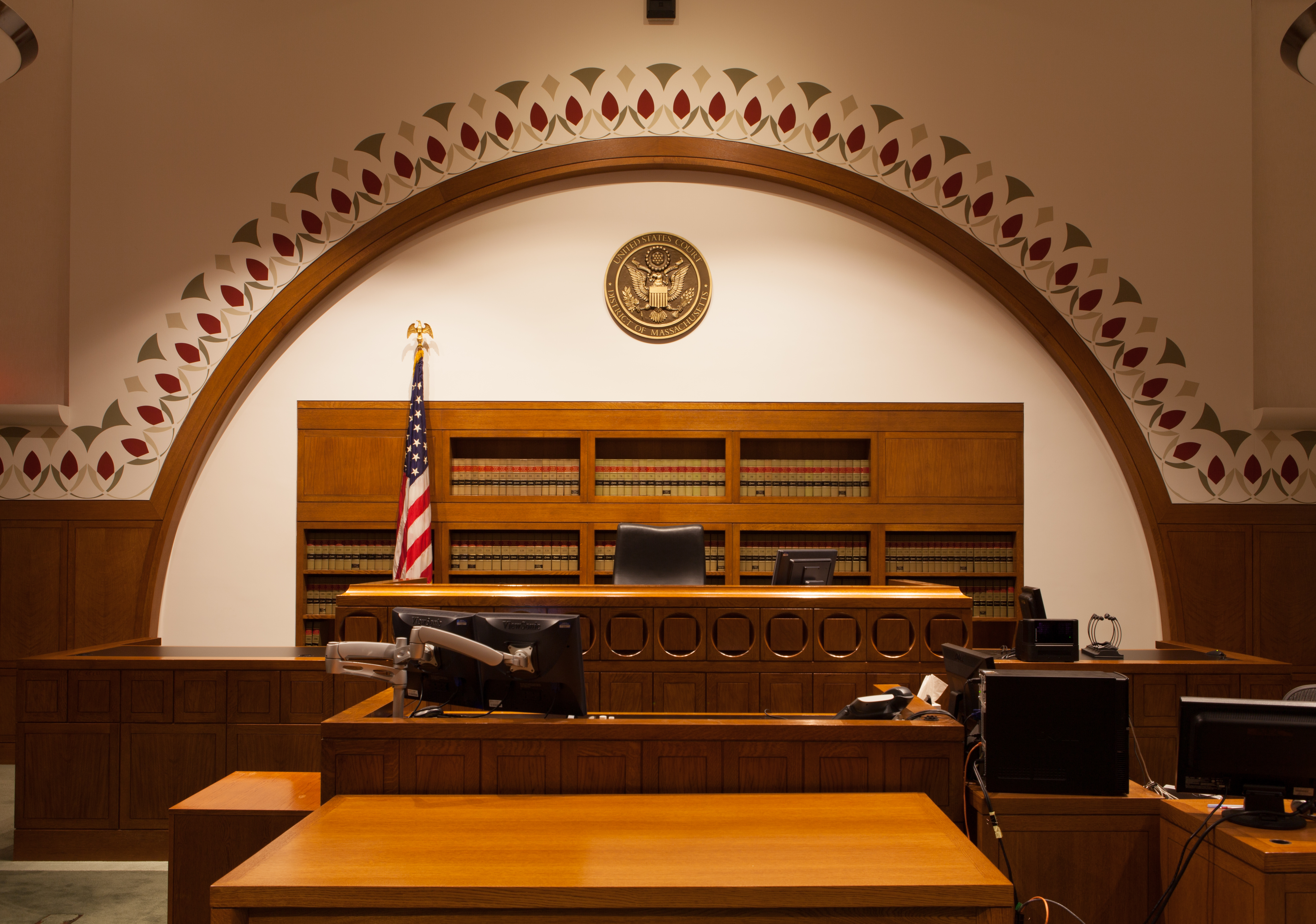
The bench of a courtroom in Mass. federal court. U.S. DISTRICT COURT FOR THE DISTRICT OF MASSACHUSETTS/Handout
WASHINGTON, Dec. 28 (ZFJ) — The federal government has been unconstitutionally targeting pro-Palestinian foreign students for deportation for protected speech, ruled a district judge on Sept. 30, 2025.
U.S. District Judge William G. Young, a Ronald Reagan nominee, came to the conclusion that Secretaries Kristi Noem and Marco Rubio of the departments of Homeland Security and State “acted in concert to misuse the sweeping powers of their respective offices to target non-citizen pro-Palestinians for deportation primarily on account of their First Amendment protected political speech” after a nine day bench trial in Massachusetts.
President Donald Trump, under executive orders Protecting the United States From Foreign Terrorists and Other National Security and Public Safety Threats and Additional Measures to Combat Anti-Semitism, said that Jewish students in “leftist, anti-American colleges and universities” were facing “an unprecedented wave of vile anti-Semitic discrimination, vandalism, and violence” as a result of the Oct. 7 attack by Hamas on Israel. In a fact sheet about the latter order, Trump said that he would “cancel the student visas of all Hamas sympathizers on college campuses.”
In furtherance of this objective, the Office of Intelligence under Homeland Security Investigations (HSI), part of U.S. Immigration and Customs Enforcement (ICE), was ordered to investigate student protesters listed on Canary Mission’s website and specifically look for immigration violations, according to testimony by the assistant director leading the office.
Canary Mission is an anonymously run doxing website that lists the personal information of students and professors that it alleges are “anti-Israel” and “anti-Semitic,” especially those who support the Boycott, Divestment, Sanctions (BDS) movement. Its database has over 5,000 people listed in it.
HSI analysts were pulled from other units (including counterintelligence, counterterrorism, cyber intelligence, global trade intelligence, and more) to compile about 100-200 reports of analysis (ROAs). This means ROAs were prepared for less than 5% of individuals investigated. Canary Mission was the primary source, with some other names provided by HSI “top leadership.”
Per the assistant director’s testimony, HSI leadership did not give his office a definition of what “supporting terrorist organizations” meant.
STUDENTS ARRESTED
In an ROA for Yunseo Chung, a legal permanent resident, investigators reported that social media posts indicated that she was a figure in the Barnard College library occupation, an event at which protesters distributed Hamas-authored flyers. There was no evidence that Chung herself gave out these flyers. Her criminal record included charges related to a previous demonstration at Barnard College.
In an ROA for Mahmoud Khalil, a legal permanent resident and spouse of a U.S. citizen. The report said that news articles and social media posts indicated that Kahlil had been critical of Israel, participated in demonstrations at Columbia University, and was a lead negotiator on behalf of Columbia University Apartheid Divest. No criminal history was noted. The office reported that he had been a key figure in the Barnard College library occupation, though it did not include evidence that he distributed flyers.
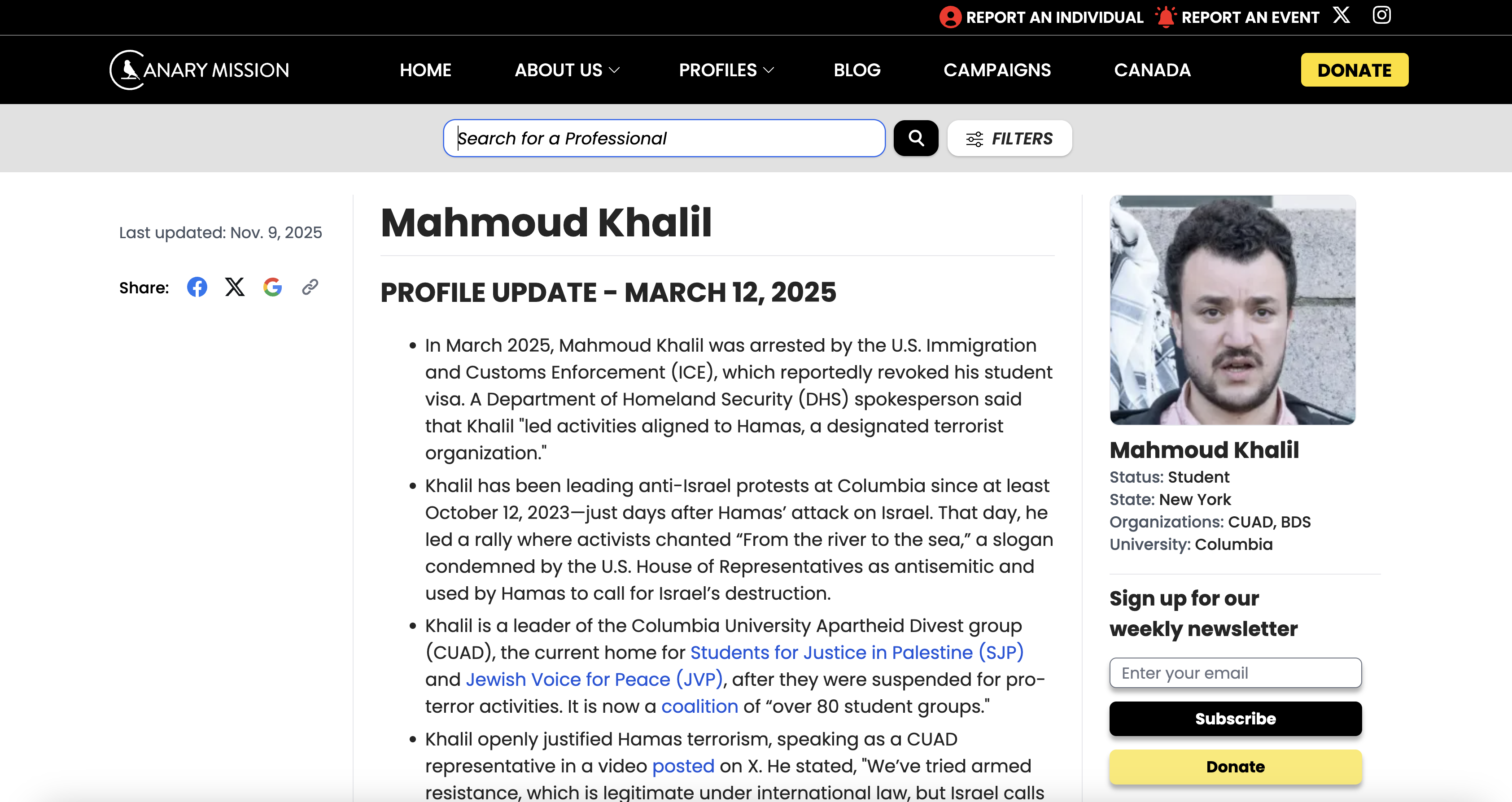 Screenshot of Mahmoud Kahlil’s profile on Canary Mission’s website on Dec. 29, 2025. ZFJ/Alvin Wu
Section 237(a)(4)(C) of the Immigration and Nationality Act (INA) allows the secretary of state to determine that an individual remaining in the country would compromise U.S. foreign policy interests, thus allowing deportation. As such, Rubio personally determined that Chung and Khalil’s activities “have potentially serious adverse foreign policy consequences and would compromise a compelling U.S. foreign policy interest” for participating in “antisemitic protests” and causing “a hostile environment for Jewish students.”
The official in charge of the State Department’s Bureau of Consular Affairs warned Rubio that this personal determination was the only grounds the government had for deporting these two people and that relying on this section of the INA was unprecedented.
The U.S. Department of Homeland Security (DHS) issued I-200 administrative arrest warrants for Chung and Khalil. Khalil was arrested in the lobby of his apartment building in New York City on March 8, 2025. Chung obtained a temporary restraining order, and then a preliminary injunction, against her arrest.
HSI issued an ROA for Badar Khan Suri, who the report listed as the spouse of the U.S.-citizen daughter of Ahmed Yousef, a senior Hamas figure. Posts by Khan Suri to Middle East Monitor and Instagram were considered to “appear” to be “pro-Palestinian content.” No criminal record was noted.
In an ROA for Mohsen Mahdawi, a lawful permanent resident, news articles and social media posts identified him as co-president of the Palestinian Student Union at Columbia University and “organizer of pro-Hamas rallies.” He had one drug seizure incident at the U.S.-Canada border in Derby, Vermont in 2019.
Both people were referred to Rubio. The consular affairs bureau head warned that investigators had “not identified any alternative grounds of removability” for them and raised constitutional concerns. ICE assessed that Suri was “actively supporting Hamas terrorism” but did not have any additional open source information.
Rubio made the determination for them. Suri was arrested in Rosslyn, Virginia, on March 17, 2025.
HSI issued an ROA for Rümeysa Öztürk, a Tufts University student on a F-1 student visa. The report included her Canary Mission profile, which linked an op-ed she wrote in support of Tufts divesting from companies with ties to Israel. It also included an article about Tufts Students for Justice in Palestine’s suspension by Tufts, although nothing in it was attributed to Öztürk.
“There is no evidence that Öztürk did anything but co-author an op-ed that criticized the University’s position on investments with Israel, that she criticized Israel, and that the organization of which she was member joined in that criticism with an organization that was banned on Tufts campus, with which she was not affiliated,” wrote the district judge.
The government revoked Öztürk’s visa on the sole basis of the op-ed she wrote. She was approached by three plain-clothes, initially unmasked, HSI agents exiting a grey SUV in Somerville, Massachusetts, adjacent to Boston, on March 25, 2025. Öztürk pulled away and screamed until an agent showed their badge and other agents appeared and identified themselves. All agents then masked up and arrested her.
Surveillance footage of Öztürk’s arrest by HSI agents. AP/YouTubeOn April 14, 2025, HSI issued an I-200 warrant for Mahdawi’s arrest. He arrived at a U.S. Citizenship and Immigration Services (USCIS) facility to take his citizenship exam, which he passed. Once the test concluded, four agents entered and arrested him. Some agents masked up when they entered a public area.
Included in evidence were repeated remarks by Trump administration officials—including Rubio, White House press secretary Karoline Leavitt, Vice President J.D. Vance, White House Deputy Chief of Staff Stephen Miller, and DHS Assistant Secretary Tricia McLaughlin—identifying pro-Palestinian students as anti-Semitic and pro-Hamas terrorists and asserting the right to revoke these students’ visas.
In one such case, Michel Martin of NPR interviewed Deputy Secretary of Homeland Security Troy Edgar about Kahlil’s arrest. When pressed for the basis on which the government accused Khalil of being a terrorist, Edgar only asserted the power to review visas.
Martin: He’s a legal permanent resident. I have to keep insisting on that. He is a legal permanent resident. So what is the standard? Is any criticism of the Israeli government a deportable offense?
Edgar: Like I said, I think at this point when he entered into the country on a student visa, at any point we can go through and evaluate what his status is.
— March 12, 2025 Interview, NPR. Findings of Fact and Rulings of Law, p. 47
INFERENCES FROM THE FACTUAL RECORD
Young writes that Secretaries Noem and Rubio never intended “to deport all pro-Palestinian non-citizens for that obvious First Amendment violation” but instead “to target a few for speaking out” and then use the INA “to have them publicly deported with the goal of tamping down pro-Palestinian student protests and terrorizing similarly situated non-citizen (and other) pro-Palestinians into silence because their views were unwelcome.”
He writes that this operation, with full support of President Trump, was successful in achieving that goal.
On the subject of ICE, Young says that it “has successfully persuaded the public that it is our principal criminal law enforcement agency” when it is actually a civil law enforcement agency. He notes that immigration courts are not truly courts but hearings before officers instead.
Young remarks that “ICE goes masked for a single reason—to terrorize Americans into quiescence,” pointing out that soldiers, some of whom have been guarding ICE agents on enforcement operations, “do not ordinarily wear masks.”
To us, masks are associated with cowardly desperados and the despised Ku Klux Klan. In all our history we have never tolerated an armed masked secret police.
— Judge William G. Young, Findings of Fact and Rulings of Law, p. 98
The judge muses about reasons for the lack of outcry—fear or apathy, he reasons—and quotes former President Abraham Lincoln to convince people to care about the plaintiffs in this case: “The only Constitutional rights upon which we can depend are those we extend to the weakest and most reviled among us.”
RULINGS OF LAW
Young observes that, “broadly speaking…’the Supreme Court [has] applied to aliens the same First Amendment test then applicable to citizens,’ with the significant exception that citizens generally cannot be deported.” He unequivocally rejects the Trump administration’s contention that non-citizens are not subject to the same free speech rights as citizens.
He then finds that the plaintiffs have shown that the “implementation of the Executive orders through the challenged enforcement steps was targeted intentionally at specific viewpoints in order to chill speech” based on officials’ “many public statements suggesting that they wished to staunch public protest related to Israel’s treatment of Palestinians.”
He observes that the officials involved in reviewing the students “spoke the language of ‘violat[ing]’ the Executive Orders, as if they were the law.”
In short, if it looked like the Executive Orders might have disapproved of it, that was potential grounds for deportation.
— Judge William G. Young, Findings of Fact and Rulings of Law, p. 132
Young infers from the “manner in which these arrests, detentions, and revocations have been conducted: by often-masked agents, without prior notice of visa revocation or altered status” that they were “in part intentionally to chill the speech of other would be pro-Palestine and anti-Israel speakers,” noting that the government “did not adjust the policy to make the arrests less obviously chilling.”
MOVING FORWARD
Young writes further, saying that he is unsure whether or not “an effective remedy might be obtainable.” He discusses the unitary executive theory, a recent legal doctrine that asserts that the president is the sole, superior force behind all Article II federal employees.
On the subject of Trump, he quotes his wife, who commented, “He seems to be winning. He ignores everything and keeps bullying ahead.” Young uses this quote to discuss Trump’s successes in limiting free speech for law firms, universities, and media outlets, and the president’s heavy focus on “retribution” against his political enemies.
To reach an appropriate remedy for the case, then, Young says that he cannot restrict the speech of the president, he can only issue a limited injunction concerning the president’s subordinates, and he cannot interfere with the government’s ability to enforce laws passed by Congress.
A hearing on remedies has been scheduled for Jan. 15, 2026. It was previously scheduled for mid-December 2025 but was canceled.
I fear President Trump believes the American people are so divided that today they will not stand up, fight for, and defend our most precious constitutional values so long as they are lulled into thinking their own personal interests are not affected.
Is he correct?
— Judge William G. Young, Findings of Fact and Rulings of Law, p. 160
Young opened his opinion with a threat he received in the mail on June 19, 2025. He ends his opinion thanking the threat’s author for caring about the case and inviting them to visit the Boston courthouse sometime and observe jurors upholding democracy sometime.
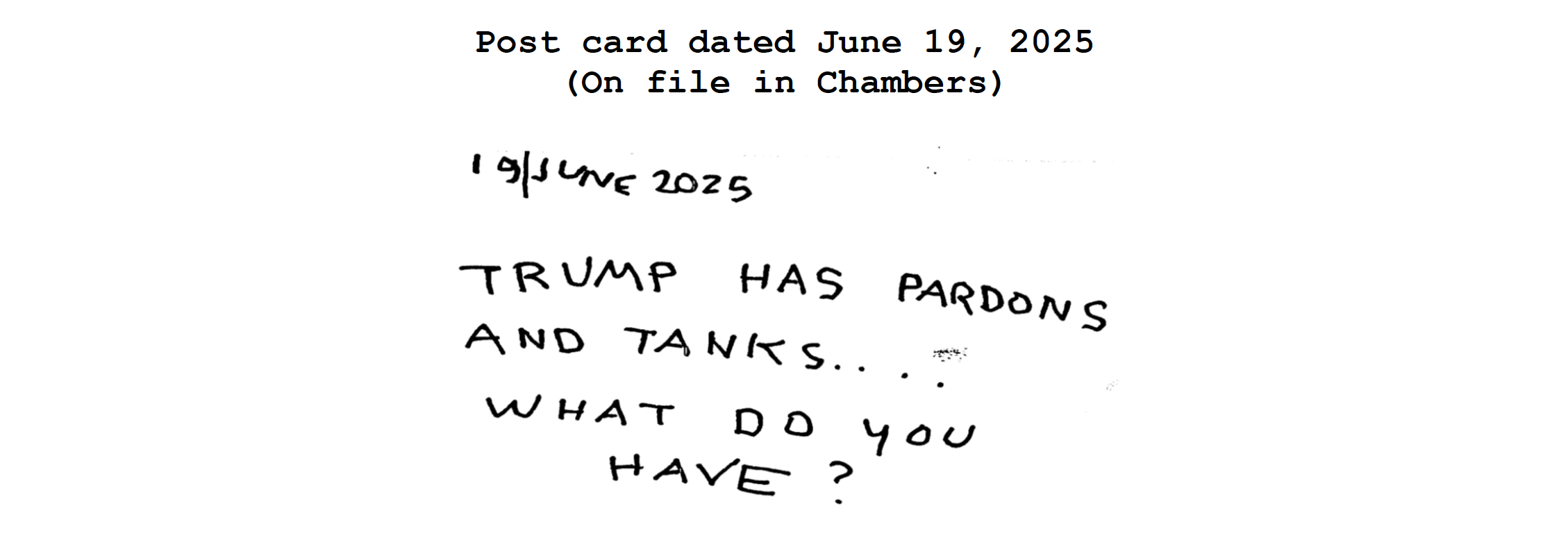 The threat Young received in the mail. AAUP v. RUBIO/ECF No. 261
The case is American Association of University Professors v. Rubio (1:25-cv-10685-WGY) in the U.S. District Court for the District of Massachusetts.
References
- U.S. District Court for the District of Massachusetts (MADC) - American Association of University Professors v. Rubio (1:25-cv-10685-WGY)
- ECF No. 261 - FINDINGS OF FACT AND RULINGS OF LAW - https://www.zfjnews.com/2025/domestic-affairs/D.Mass._1_25-cv-10685-WGY_261_0.pdf
- The White House - PROTECTING THE UNITED STATES FROM FOREIGN TERRORISTS AND OTHER NATIONAL SECURITY AND PUBLIC SAFETY THREATS - https://www.whitehouse.gov/presidential-actions/2025/01/protecting-the-united-states-from-foreign-terrorists-and-othernational-security-and-public-safety-threats/ (ARCHIVE)
- The White House - Additional Measures to Combat Anti-Semitism - https://www.whitehouse.gov/presidential-actions/2025/01/additional-measures-to-combat-anti-semitism/ (ARCHIVE)
- American Association of University Professors - Court Rules in AAUP v Rubio: Trump Admin Violated First Amendment - https://www.aaup.org/news/court-rules-aaup-v-rubio-trump-admin-violated-first-amendment (ARCHIVE)